
Analysis of secondary image in Head-Up Display (HUD) system
Effectivity: Global 5000/5500/6000/6500/7500 aircraft
ATA: 34-32
By: Dan Martin – Technical Services Bombardier received a field report related to a HUD secondary reflected image observed under certain lighting conditions (inside the hangar). Refer to the following picture:
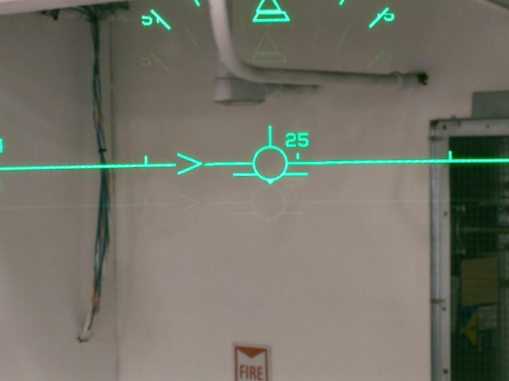
This phenomenon is known and well-characterized within the optical combiner system and has been previously accounted for in the system design. Based on our review of the photometric characteristics and qualitative assessment of available imagery, the secondary image appears to fall within this <1% luminance threshold as defined in the HUD engineering specification.
While exact quantitative measurement cannot be obtained from photographs alone, the observed relative intensity is consistent with expected system performance and design predictions.
The secondary image is formed due to internal reflections within the HUD combiner, specifically:
Primary reflection
The main image is reflected toward the pilot from the front (air-to-combiner) boundary of the optical combiner. This is the intended optical path and produces the primary collimated symbology.Secondary reflection mechanism
A small portion of the optical wavefront passes through the front surface into the substrate;
This wave then reflects from the back surface of the combiner;
The reflected light passes again through the glass and exits toward the pilot.
Because the light is refracted twice while passing through the combiner substrate, the secondary image appears spatially offset from the primary image. This effect is inherent to the optical geometry and materials of the combiner and is not indicative of a malfunction.
The visibility of the secondary image strongly depends on ambient lighting and HUD brightness configuration:
High ambient lighting (e.g., bright daylight operations)
The HUD is typically set to maximum brightness;
Ambient luminance is sufficiently high to wash out the secondary image, making it effectively invisible;
This is the operational condition for which the HUD brightness system is calibrated.
Low ambient lighting (e.g., inside a hangar)
If the HUD is set to full brightness in a dark or dim environment, the secondary image may become visible;
This is normal and expected due to reduced ambient washout, allowing the <1% luminance secondary image to be perceptible.
In real operational use, pilots would not set the HUD to maximum brightness under low-light conditions, so the visibility of the secondary image under these test conditions does not represent typical in-service behaviour.
The operator has noted differences in the secondary image between the left-hand and right-hand HUD systems. Two primary factors can contribute to this variation:
Brightness potentiometer variation
Even when both potentiometers meet tolerance requirements, slight variations in the resistance value at full bright can produce small differences in optical output intensity. This can lead to perceptible differences in the strength of both primary and secondary images from left to right HUDs.Lens alignment and optical geometry
The internal lens angles between left-hand and right-hand units differ slightly due to geometric constraints. These differences can introduce minor optical variations, including the position and intensity of secondary reflection.
Both effects fall within expected manufacturing tolerances and do not represent a deviation from specification.