
Desert operation guidelines
Effectivity: Challenger 604/605/650 aircraft
Infoservice
Aircraft operating in desert regions are exposed to air that carries a high concentration of dust, seasonally combined with extreme heat and in coastal areas, a high humidity.
Other than the exposure on the ground, dust from desert sand and construction sites are also carried to altitude by strong winds and sandstorms.
Ingestion of dust and sand will degrade components typically in the engines, air conditioning and pressurization systems, while the high temperatures affect engine performance and electronic components.
Whilst the Environmental Corrosion Control and Prevention Guidelines are addressing corrosion, exposure to sand, dust and extreme heat will require special attention for a number of components and systems, in addition.
This publication is a compilation of references and information to be used as a guide assisting maintenance departments in developing customized
maintenance practices when operating in desert regions and other areas with a high concentration of airborne pollutants.
Information published in this Infoservice is considered accurate. However, the data published in our manuals takes precedence at all times.
The document is subject to revision, and it’s recommended to always obtain the latest version from the portal whenever referenced.
Revision status of the tasks presented are controlled within their respective publications. Any such revisions are not automatically updated in this document.
The following significant changes have been made under Rev 02:
• Engine wash criteria amended incl. addition of 400 H interval
• Engine longevity guidance added
• TMLC task intervals reduced by 50%
• Cleaning of Water Separator (MPD 3.2) moved to 400 H
• Document title changed to: DOG CL6XX
ATA 10 - Parking
AMM Task
Task: 10-10-04-400-801
Subject: Installation of the Covers and Plugs
Benefits:
Covers and plugs will prevent sand and dust ingress in critical areas.
Whenever parking on the ramp in desert region airports and airfields, whether short- or long-term, it’s important to protect the aircraft against the elements. In particular the use of engine covers is critical in order to prevent dust contamination of the internal cooling as well as erosion and sand build-up.
If parked for longer periods, the external windshield cover will help provide protection from the sunlight and small particle impact caused by strong winds and jet blast. It’ll also help prevent erosion of the aerodynamic seals.
MPD Reference
Task: Section 3.1 – Optional Maintenance
Subject: Walk Around Inspection
Benefits:
Increase dispatch availability. Regular walk around inspections carried out by a technician, who’ll also be able to carry out any servicing required, will help maintain operational readiness.
Note: With no scheduled flights or general maintenance planned for up to 7 days, Short-term parking is applicable (AMM TASK 10-10-01-587-801).
And if parked for more than 7 consecutive days, the Long-term procedure is applicable (AMM TASK 10-10-01-587-802).
ATA 12 - Servicing
AMM Tasks
Task: 12-20-01-110-802
Subject: Cleaning of the Aircraft Windows and Windshields
Benefits:
Regular cleaning of the windshield and side windows including the weather- and hump seal, will help prevent FOD and maintain the seal integrity, preventing moisture and sand ingress.
Task: 12-20-01-110-801
Subject: Cleaning of the External Aircraft Surfaces
Benefits:
Cleaning the aircraft external surfaces regularly prevents the accumulation of sand and dust mitigating, corrosion, contamination and degradation.
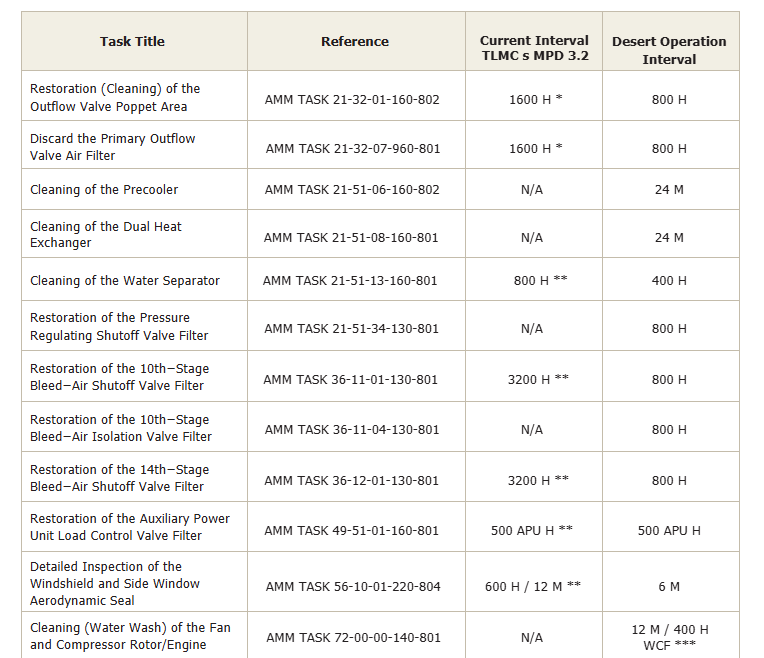
Desert Operation Task Intervals
Effectivity: Challenger 604/605/650
Note:
* These tasks are also included in the TLMC 05-21-10.
** These tasks are also included in the MPD 3.2 Optional Maintenance.
*** Wash frequency is also depending on engine trend and to be determined by the operator.
ATA 21 - Air Conditioning
AMM Tasks
Task: 21-32-01-160-802
Subject: Restoration (Cleaning) of the Outflow Valve Poppet Area
Benefits:
Accumulation of dust incl. Nicotine and tar contamination at the seating surfaces of the outflow valve poppet areas, will affect proper operation of the OFVs. The TLMC calls for cleaning of the OFV poppet surface areas every 1600 flight hours. Cleaning more frequently, removing any contamination early, will help maintain proper OFV operation.
Task: 21-32-07-960-801
Subject: Discard the Primary Outflow Valve Air Filter
Benefits:
A contaminated - dirty air filter on the Primary OFV will impede the airflow into the actuator chamber, preventing smooth, free movement of the OFV poppet. This condition will affect the rate of pressurization/depressurization. The TLMC calls for replacement of the air filter every 1600 flight hours. Replacing the filter earlier will help ensure proper operation of the OFVs, preventing pressurization issues.
Task: 21-51-06-160-802
Subject: Cleaning of the Precooler
Benefits:
Sand, dust and other airborne pollutants will gradually accumulate in the precooler, restricting the airflow and heat transfer with the risk of causing an ACU overheat. Scheduled regular cleaning of the precooler will not only help ensure consistent cooling but also mitigate the accumulation of contaminants in the downstream components.
AMM Tasks
Task: 21-51-06-160-802
Subject: Cleaning of the Precooler
Benefits:
Exposed directly to the elements, the dual heat exchanger is vulnerable to FOD and particle ingestion. Sand, dust and other airborne pollutants will gradually accumulate in the heat exchanger, restricting the airflow and heat transfer with the risk of causing an ACU overheat. Scheduled regular cleaning of the dual heat exchanger will not only help ensure consistent cooling but also mitigate the accumulation of contaminants in the downstream components.
RIL Reference
Document: RIL CL-0059
Subject: Precooler and Dual Heat Exchanger - On-Wing Cleaning
Benefits:
Sand, dust and other airborne pollutants will gradually accumulate in the precooler and dual heat exchanger, restricting the airflow and heat transfer with the risk of causing an ACU overheat. Scheduled regular cleaning of the precooler and dual heat exchanger will not only help ensure consistent cooling but also mitigate the accumulation of contaminants in the downstream components.
Note: This task can be carried out as an alternate procedure to the AMM/CMM cleaning tasks of the precooler and dual heat exchanger, or if deemed necessary prior to
the proposed interval.
AMM Tasks
Task: 21-51-13-160-801
Subject: Cleaning of the Water Separator
Benefits:
Contaminants making it through the precooler, dual heat exchanger and cooling turbine will gradually accumulate in the water separator, eventually impeding the water separation. Scheduled regular cleaning of the water separator will help ensure consistent cooling.
Task: 21-51-34-130-801
Subject: Restoration (Cleaning) of the Pressure−Regulating Shutoff Valve Filter
Benefits:
Impurities contained in the bleed air will gradually accumulate and contaminate the PRSOV inlet filter. A partially or fully blocked filter will impede the airflow actuating the valve, preventing it from opening to the commanded position, resulting in low duct pressure. Scheduled regular cleaning or replacement of the filter will help maintain the required 10th stage duct pressure.
Note: Rather than deaning, replacing the filter will be more efficient, ref CMM 36-11-69.
ATA 36 - Pneumatic
AMM Tasks
Task: 36-11-04-130-801
Subject: Restoration (Cleaning) of the 10th−Stage Bleed−Air Isolation Valve Filter
Benefits:
Impurities contained in the bleed air will gradually accumulate and contaminate the SOV inlet filter. A partially or fully blocked filter will impede the airflow actuating the valve, preventing it from opening to the commanded position, resulting in low duct pressure. Scheduled regular cleaning or replacement of the filter will help maintain the required 10th stage duct pressure.
Note: Rather than deaning, replacing the filter will be more efficient, ref. CMM 36-11-69.
Task: 36-11-04-130-801
Subject: Restoration (Cleaning) of the 10th−Stage Bleed−Air Isolation Valve Filter
Benefits:
Impurities contained in the bleed air will gradually accumulate and contaminate the ISOV inlet filter. A partially or fully blocked filter will impede the airflow actuating the valve, preventing it from opening to the commanded position, resulting in low duct pressure. Scheduled regular cleaning or replacement of the filter will help maintain the required 10th stage duct pressure.
Note: Rather than cleaning, replacing the filter will be more efficient, ref. CMM 36-11-69.
AMM Tasks
Task: 36-12-01-130-801
Subject: Restoration (Cleaning) of the 14th−Stage Bleed−Air Shutoff Valve Filter
Benefits:
Impurities contained in the bleed air will gradually accumulate and contaminate the SOV inlet filter. A partially or fully blocked filter will impede the airflow actuating the valve, preventing it from opening to the commanded position, resulting in low duct pressure. Scheduled regular cleaning or replacement of the filter will help maintain the required 14th stage duct pressure.
Note: Rather than cleaning, replacing the filter will be more efficient, ref. CMM 30-10-33.
ATA 49 - Airborne Auxiliary Power
Task: 49-51-01-160-801
Subject: Cleaning of the Auxiliary Power Unit (APU) Load Control Valve Filter
Benefits:
Impurities contained in the APU bleed air will gradually accumulate and contaminate the load control valve inlet filter. A partially or fully blocked filter will impede the airflow actuating the valve, preventing it from opening to the commanded position, resulting in low duct pressure. Scheduled regular cleaning or replacement of the filter will help maintain the required 10th stage duct pressure.
Note: Rather than deaning, replacing the filter will be more efficient, ref. AIPC 49-51-01.
ATA 56 - Windows
AMM Tasks
Task: 56-10-01-220-804
Subject: Detailed Inspection of the Windshield and Side Window Aerodynamic Seal
Benefits:
With exposure to extreme heat, strong winds, sand, dust and condensation, the cockpit windows and their aerodynamic seals will need frequent attention. If the seals are allowed to erode, it’ll increase the risk of moisture and sand ingress, causing delamination and failure of the heating system. In case of any damage or seal deterioration, the
CMM will help determine the action required, and if permitted the AMM will provide the applicable repair instructions. Regular scheduled inspections will reveal degradation early and help mitigate a failure.
Note: For non-hangared aircraft parked in desert regions, it’s highly recommended to use the windshield cover listed in the ITEM 10-20-04. Windshield and Side Window Inspection Guidelines
ATA 72 - Engine
AMM Tasks
Task: 72-00-00-140-801
Subject: Cleaning (wash) of the Fan and Compressor Rotor/Engine
Benefits:
For aircraft parked on the ramp in desert region airports and airfields, diligent use of engine covers will greatly reduce the adverse effects of particle erosion and contamination. However, when flying, particularly at low altitude, ingestion of dust and other airborne pollutants cannot be avoided.
Washing the engines regularly will help prevent build-up of particles blocking the internal cooling, thus mitigating degradation and loss of ITT margin.
Note: It’s recommended to dry motor the engines for at least 2 minutes prior to washing. In case the aircraft has been exposed to severe dust and sand conditions, the following procedure applies: CF34BJ SEI-780 SM 72-00-00 ENGINE - INSPECTION.
Maintenance & Operational Guidance
Task: AMP tasks referenced in this document.
Subject: Engine longevity
Benefits:
Engine cleanliness and ITT management are the two main drivers to help preserve engine life.
Keeping the engines clean is accomplished with the use of covers and/or a hangar,
dry motoring and washing.
Maintaining a healthy ITT margin when operating in areas with extreme seasonal heat requires special consideration with respect to thrust settings. During periods with elevated temperatures, at takeoff, it’s recommended to use the maximum assumed temperature thrust reduction that meets performance requirements.
Final Thoughts
The recommended tasks coincide with existing MRBR inspection intervals, keeping the operational inconvenience to a minimum. However, depending on the operation, it might be more beneficial to carry out some of these tasks seasonally, before the summer heat, e.g.
Ultimately, it’s at the discretion of the operator to compile a program tailored to the operational environment. Along with the regulatory requirements, the MRBR always takes precedence.
Customer Advisory Committees
Customer Advisory Committees are establishing an open dialogue with Bombardier aircraft owners and operators. This engagement is invaluable and helps us to identify our strategy and priorities, focusing on areas in which we can improve and those in which we need to continue our efforts. Listening to our customers and their needs is a crucial part of our continued success, bringing the best product to the market.
If you wish to attend an upcoming Advisory meeting or submit a proposed new fleet issue, please fill out the appropriate forms on the Customer Advisory Committees page in the Events section of the Customer Portal.