
Forward Avionic Rack Fan (FARF) filter maintenance
Effectivity: Global 7500/8000 aircraft
ATA: 21
By: Yanick Fournier, Technical Services This document provides operational and maintenance information for the Forward Avionic Rack Fan (FARF) filter.
The FARF filter is installed below the cabin floor and is intended to prevent dust and debris contamination of the avionics and electrical equipment installed in the Forward Avionic Rack.
The filter has a life limit of 1,700 flight hours (FH). However, the effective service life may be reduced by operational and environmental conditions, including but not limited to:
Extended ground operation with passenger door open
Operations in harsh environments (sand, dust, industrial pollution)
High personnel traffic at the aircraft entrance during ground operations
Cabin-generated contaminants (carpet fibers, cabin dust)
When the filter becomes partially or fully clogged, flight or ground crew may notice a humming or increased noise originating from the underfloor area in the forward part of the aircraft. In flight, avionics cooling capability is not compromised, as air extraction is still assured by the Avionics Bay (AVB) fan. In the event of FARF failure, the AVB fan will compensate by operating at a higher speed. In case of clogging, a temporary disposition (10 days) is available on the Bombardier portal (Ref. REO 700-21-54-006) to allow time to get the part.
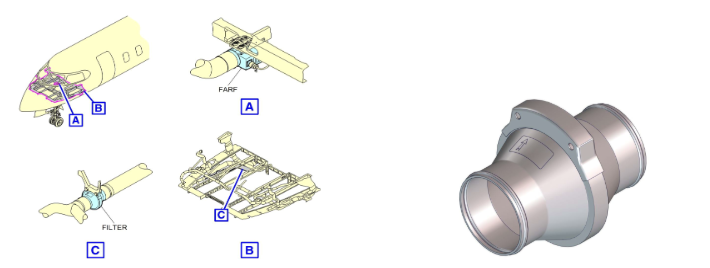
Due to the extensive use of ground power during aircraft manufacturing and pre-delivery activities, Bombardier replaces the FARF filter prior to delivery on all aircraft. As a result, all aircraft are delivered with a new filter installed.
Operators may adjust the FARF filter maintenance interval based on their specific operating environment and utilization profile. A recommended method to establish an appropriate interval is an initial inspection at 1,000 FH, followed by subsequent inspections at 200 FH increments, allowing condition-based assessment and interval optimization.